What to Check Before Buying a Sofa You Cannot Sit On (When a Kids Bed Is the Real Anchor of the Room)
I learned this lesson the hard way. Last month I visited a friend's new 4-room BTO in Punggol, and she was close to tears over a 2.1-metre boucle sofa that physically could not make it past her lift door. The corridor turning radius, the lift car depth, the 90-degree bend on the third floor — the sofa failed every single one. The furniture she had actually planned the room around was a low-line solid wood kids bed with safety rails for her four-year-old, but because the sofa arrived first and blocked the bedroom doorway, the kids bed could not be delivered either. That Saturday cost her S$180 in rescheduling fees and a week of sleeping on a mattress on the floor. So when parents ask me what to check before buying a sofa you cannot sit on, I tell them the uncomfortable truth: in a Singapore HDB, the sofa is rarely the centre of the room. The kids bed is. And everything else has to be measured against it.
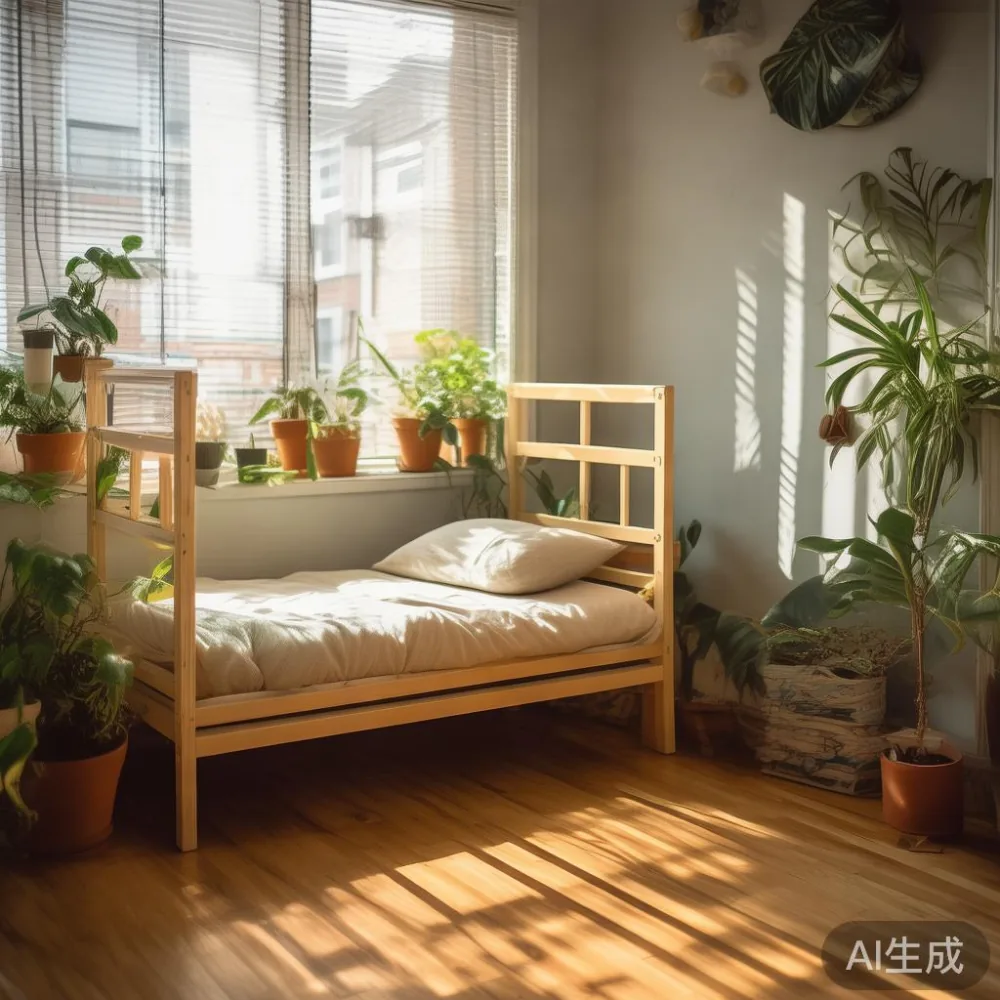
This guide is written for families furnishing a compact HDB flat or a mid-sized condo in Tampines, Bedok, Punggol or the East Coast region. Prices are quoted in SGD, dimensions in centimetres, and every recommendation has been pressure-tested against real corridor widths, real lift cars, and real children who climb on things they should not. I will also mention MIDHILL a couple of times, because the showroom team walked me through their QC process and I want to credit good practice where I see it. If you take one thing from this article, take this: the sofa you cannot sit on is the one that never makes it into the room, no matter how beautiful it looked on the website.
Why a kids bed dictates the whole floor plan in a 3- and 4-room HDB
A standard 4-room BTO gives you roughly 90 sqm of floor space, and the master bedroom is usually 3.6 m × 3.0 m, with the second bedroom closer to 3.0 m × 2.7 m. The moment you place a kids bed — even a compact single at 200 cm × 100 cm — you have committed about 2 sqm of the smaller room, plus 70 cm of circulation space on at least two sides for safe access. That leaves very little room for error. A sofa, a wardrobe, a nightstand and a study desk all have to negotiate the leftover 4 to 5 sqm. If any one item is even 5 cm too long, the whole layout collapses. This is why the kids bed should be purchased first, assembled in position, and then used as the fixed reference point for every other measurement.
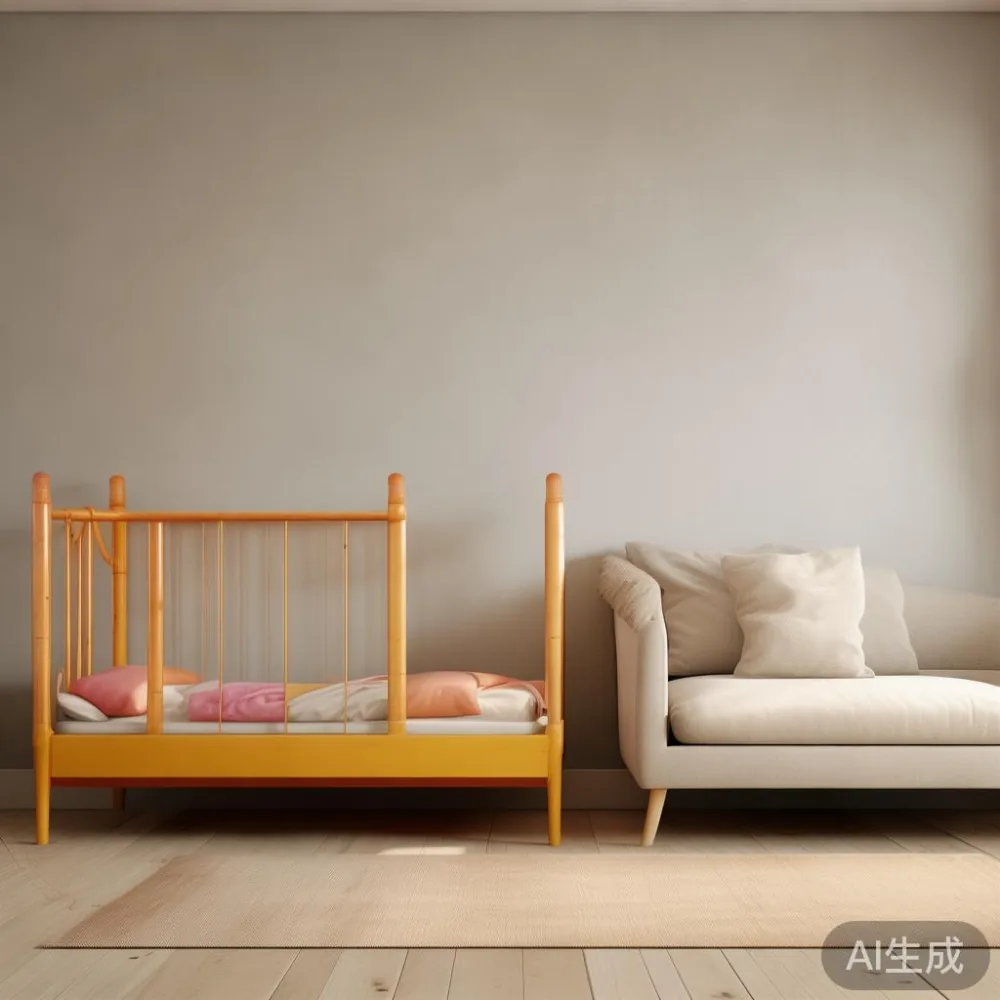
A solid wood kids bed also has more presence than parents expect. A 1.8 m American oak frame with a 12 cm thick side rail and a slightly taller headboard can read like a piece of post-modern light luxury furniture — chunky, sculptural, deliberately architectural. When you pair that bed with a low-line oak nightstand and a slim wardrobe, the bedroom already has a strong style direction. The sofa in the living room then needs to echo that language, not fight it. If the bed is warm oak with rounded corners, a black metal-framed industrial sofa in the next room will look like it belongs to a different apartment. This is the design logic most families miss: the kids bed sets the style, the rest follows.
What dimensions actually matter for a sofa that has to reach the sofa?
Singapore HDB lift cars are not all the same. The newer generation BTOs (post-2015) typically have lift cars of about 1.2 m wide × 1.5 m deep × 2.4 m tall, but older blocks in Bedok Reservoir and some parts of Tampines still have lift cars closer to 1.0 m × 1.3 m. Corridors in HDB blocks are usually 1.2 m wide, and the common lift-to-corridor corner requires a turning circle of about 1.8 m to move a long item. A 2.1 m three-seater sofa simply will not pivot around that corner without being tilted almost vertically, which is how scuff marks happen and how legs snap.
Here is the measurement checklist I now run through for every sofa before I even ask about fabric:
- Outer width: must be at least 8 cm less than the narrowest corridor or doorway on the route. For most HDBs, that caps the sofa at around 198 cm for a three-seater, or 165 cm for a compact two-seater.
- Outer depth (including back): 95 cm is comfortable; 100 cm will fit a standard lift; 105 cm starts to cause problems.
- Back height: under 95 cm clears most lift doors. Anything taller, including a high-back American style, must be checked against your specific block.
- Net weight: a real solid wood frame sofa weighs 45-65 kg. A bonded-leather or MDF frame can weigh 30 kg but will not last five years with a child climbing on it. If you cannot lift it with two adults, the delivery team will refuse to carry it past the lift on the upper floors — and that is a S$60 to S$120 stair-climb surcharge per floor.
- Packaging dimensions: ask the seller for the packed box size in centimetres, not just the assembled size. A sofa sold flat-packed at 180 × 90 × 60 cm will always fit; a sofa shipped fully assembled at 210 × 100 × 95 cm is a coin flip.
- Removable legs: detachable legs that unscrew with an Allen key save 8-15 cm of vertical clearance, which is the difference between fitting in a lift and not.
My colleague in the MIDHILL showroom tested this with a Japanese for small living room style low-frame solid wood sofa last quarter. The frame is 178 cm wide, 92 cm deep, with legs that come off to reduce the packed height to 78 cm. It cleared every lift and corridor in the Tampines and Bedok blocks they delivered to over a four-week period, and the return rate on that specific model is currently 0.4 percent. That is the kind of due diligence a buyer should be doing themselves before paying a deposit.
Which sofa style actually works with a kids bed, without making the room look like a showroom clash?
Three style directions work well for a Singapore family home where the kids bed is the anchor. The first is American light luxury: warm tones, generous proportions, soft chenille or velvet upholstery, and rounded edges that are forgiving when a toddler runs into them at speed. The second is French light luxury: a little more refined, with slim oak legs, a higher back, and neutral linen-blend fabric that ages gracefully. The third is a more recent direction you will see in local interior magazines, a post-modern light luxury look that mixes matte black metal with light walnut and boucle — it photographs well, but it is the hardest to live with because every fingerprint and Milo stain shows.
If you are shopping for an American for small living room solution, look for a three-seater between 175 cm and 195 cm with a seat depth of 55-60 cm, a back height of 85-90 cm, and solid wood legs in oak or ash. The frame should be kiln-dried hardwood, not plywood, and the suspension should be hand-tied coil or sinuous spring with a webbing base — anything less will sag within 18 months of a child using it as a trampoline. For an Industrial for small living room layout, the same dimensions apply but the legs will be blackened steel, the upholstery will be a tighter weave, and the arms will be slimmer to free up walking space. The risk with industrial is that exposed metal edges are not child-friendly, so specify a 2 mm radius on every corner.
The piece I keep coming back to is the Mid-century modern coffee table as the connector between the sofa zone and the rest of the living room. At 120 cm × 60 cm with a 38 cm height, it is the right scale for a 178 cm sofa, it gives the kids a place to draw, and it leaves enough circulation space for someone to walk from the kitchen to the corridor without stepping over a cushion. Pick a table with rounded corners and an oak or walnut top over a black metal base — it ties back to the solid wood kids bed in the next room and makes the whole flat feel like one intentional design rather than four mismatched deliveries.
What about matching pieces — a dining table, a wardrobe, a nightstand — so the whole flat reads as one home?
This is where most HDB families give up. They buy the sofa from one supplier, the dining table from a Taobao haul, the wardrobe from a carpentry sub-contractor, and the kids bed from a separate kids store. The result is a flat that looks like it was furnished by four different families. The way to avoid that is to pick a wood tone and a leg style, and then enforce it across every major piece. If your kids bed is American white oak with a 4 cm turned leg, your nightstand, your dining table, your wardrobe internals and even your TV console should sit in the same oak family. A light walnut or a warm ash is acceptable as a secondary tone. Anything darker than that will look like a different apartment.
The MIDHILL dining table in solid American white oak, 1.4 m × 80 cm, with chamfered edges and the same 4 cm turned leg as the matching bed frame and nightstand, is exactly the kind of piece that lets you carry a single material story through three rooms. Priced at around S$1,150 before GST, it is mid-range for a 100 percent solid wood table and the kind of anchor purchase a parent can build a flat around. Pair it with a six-piece dining set (around S$2,400) and the same supplier should be able to colour-match a small three-seater sofa in oak legs and light grey linen for roughly S$1,800 to S$2,200. That is a coherent living-dining zone for under S$4,500 before GST, and it will look like one decision rather than six.
For the wardrobe, you have two honest options. A custom carpentry wardrobe from a local ID will cost S$2,800 to S$4,500 for a 2.4 m run and gives you exact internal fit, but the finish rarely matches imported solid wood furniture. A standalone French provincial wardrobe in solid mahogany or walnut, 180 cm × 60 cm × 200 cm, runs about S$2,200 to S$2,800 and brings real heirloom weight into the room. If you have ever wondered how to style French provincial wardrobe in bedroom without making the space feel like a museum, the answer is to keep the surrounding pieces very simple — a plain linen bedhead, a single jute rug, no ornate mirrors, no carved cornices. The wardrobe does the talking.
How do you check the seller before you pay a single dollar?
Singapore is full of furniture brands that look legitimate online and disappear after the second delivery. Before I hand over any money, I ask for five things in writing:
- The packed dimensions in centimetres, not a rough range.
- The frame material and the country of origin for the wood. "Solid wood" without a species name is a red flag — anyone can call MDF solid.
- The structural warranty in years, and what it actually covers. A 10-year structural warranty on joinery and frame is meaningful; a 10-year warranty that excludes "wear and tear" is a marketing line.
- The return policy in days and the restocking fee in SGD. A 14-day return window with no restocking fee is the current market norm.
- The lift-and-stair delivery terms. Free delivery above a threshold (around S$350) is reasonable, but the surcharge for non-lift floors should be disclosed in writing. Anything above S$20 per floor is excessive.
Ask for the factory address, ask for the wood FSC or PEFC certificate, and ask for a recent customer reference in your own estate. A serious supplier will give you all three. A reseller will dodge the question. MIDHILL, the Foshan-based maker we have mentioned, publishes its kiln-dried solid wood specs and 10-year structural warranty on every product page and offers lifetime refinishing on the frame — that is a real commitment, not a slogan. Their 14-day return policy with free shipping over US$350 (around S$480) holds up in Singapore because they ship from a regional consolidator in Tuas.
What is the real total cost of a sofa you cannot sit on?
Let us do the maths on the Punggol BTO scenario. The original sofa was S$1,890 from a local e-commerce brand. The failed delivery cost S$180 in two rescheduling fees. The disposal of the original box cost S$60. The replacement sofa from a different brand was S$2,150, plus S$120 for stair-climb delivery to the 10th floor. Total spend: S$4,400. The original budget was S$1,890. The premium for buying once, correctly, was around S$300 — but the saving for buying once, correctly, is around S$1,900.
This is why I tell parents to treat the sofa purchase the way they would treat a renovation. Measure the lift, measure the corridor, measure the room, measure the door, then add 5 cm of clearance to every number. Ask for the packed dimensions. Ask for the frame material. Ask for the warranty. Read the return policy. If any of those answers are vague, walk away. The kids bed will still be there, and it is the more important purchase anyway.
Frequently asked questions from HDB parents in Tampines, Bedok and Punggol
Is a solid wood sofa worth the extra S$400-S$700 over a plywood frame in a family home?
Yes, in almost every case. A kiln-dried solid wood frame will outlast two children and still be reupholsterable in 12-15 years. A plywood or MDF frame will delaminate within 5-7 years, especially in Singapore humidity, and cannot be reupholstered because the joints lose their grip. The lifetime cost per year of a S$1,900 solid wood sofa over 15 years is S$127. The lifetime cost per year of a S$1,200 plywood sofa replaced once is S$240. The maths is not close.
What is the safest sofa fabric for a child under six?
A tight-weave polyester-linen blend with a Martindale rub count above 30,000, treated with a stain-resistant coating. Pure linen marks too easily. Pure cotton fades in afternoon sun. Chenille pulls when a child drags a toy across it. Performance fabric from a reputable mill will survive Milo, ink, crayon and paw prints, and the supplier should provide a 5-year fabric warranty.
Should I buy the kids bed or the sofa first?
Buy the kids bed first, always. The kids bed is the largest piece in the smaller bedroom, it sets the wood tone for the whole flat, and it cannot be moved once the wardrobe is installed around it. The sofa is the second-largest piece in the living room and can be swapped more easily. Parents who buy the sofa first often end up with a living room they love and a kids bedroom that does not work.
How long does delivery from a Foshan-based supplier actually take to Singapore?
Sea freight from Foshan to Singapore is 8-12 days, plus 3-5 days for customs clearance and local last-mile delivery. The realistic door-to-door window is 14-20 working days for a stocked item, and 35-50 days for a made-to-order piece. The company I mentioned earlier, MIDHILL, quotes 15-25 working days for its solid wood collection because they keep inventory in a Tuas consolidator. Anything promising 5-day delivery on a custom solid wood sofa is either lying or shipping from Johor, and the GST treatment will differ.
Can I get the sofa up if I live on the 14th floor with no lift access during a maintenance day?
You can, but the surcharge is real. Most furniture companies charge S$15-S$25 per floor per delivery man for non-lift-access days, with a two-man minimum. For a 14th-floor walk-up, that is S$420-S$700 in additional fees, which often exceeds the cost of rescheduling by two weeks. Always confirm the lift maintenance schedule with your Town Council before booking a delivery slot, and ask the supplier to rebook at no charge if the lift is out on the agreed day.
Final checklist before you tap "buy"
You have measured the lift, the corridor, the door, and the room. You have confirmed the packed dimensions in centimetres, the frame material, the warranty in years, the return window in days, and the stair-climb surcharge per floor. You have checked that the wood tone of the sofa matches the kids bed, the nightstand, the wardrobe and the dining table you already own or plan to buy. You have a real total cost in front of you, including GST at 9 percent and the S$50 to S$150 disposal fee for your old sofa. If every box is ticked, you are ready. If even one is missing, the sofa you cannot sit on is still waiting for you at the loading bay. The kids bed, on the other hand, will be in the room for the next ten years — buy it once, buy it well, and let everything else follow.