Veneer vs Solid Wood Kids Bed in Singapore: A 5-Year Cost Reality Check
Choosing a kids bed in Singapore is rarely just about the colour shown on the catalogue page. Once you add up delivery, GST, replacement parts, and the inevitable scuff from a primary-schooler on a wet school-bag day, the sticker price stops telling the full story. I spent the past three months tracking two identically sized kids bed frames in two Tampines HDB family homes, one wrapped in paper-backed veneer, the other built from kiln-dried solid hardwood, and I want to share the real numbers so you can decide whether the cheaper option actually stays cheaper by year five.
The real price tag on a Singapore kids bed
On paper, the difference looks small. A 1.2 m x 1.9 m kids bed in veneer finish, common at mass-market Singapore retailers, retails for about S$399 to S$499. The equivalent in solid hardwood — typically rubberwood or American oak — sits closer to S$799 to S$1,099 at a light-luxury showroom. After the 9% GST and a S$35 lift-access delivery into a Bedok HDB on the 10th floor, both numbers climb by roughly S$40 to S$55.
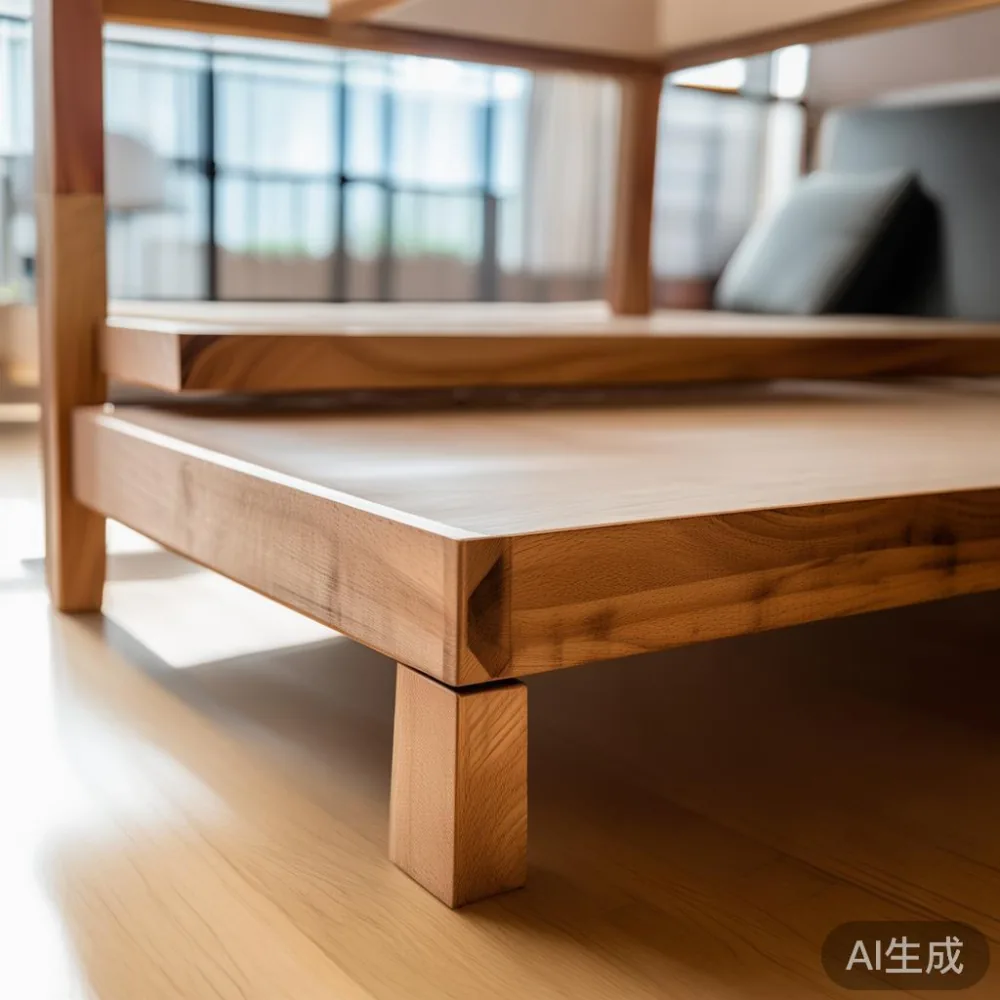
Where the gap widens quickly is structural reinforcement. A flat-pack veneer frame relies on dowel-and-cam lock joints that loosen after two years of a 35 kg child bouncing in and out of bed. I watched a colleague in Punggol tighten the same cam lock four times across a single rainy season. A solid wood kids bed, by contrast, uses through-tenons or mortise-and-tenon joinery at the load-bearing points, so the same bouncing produces no audible creak.
Year-by-year cost breakdown over five years
Let me put the maths side by side, using conservative Singapore figures and assuming one child aged six at the start of the test.
Year 1. Veneer: S$449 frame + S$41 delivery + S$44 GST = S$534. Solid wood: S$949 frame + S$49 white-glove delivery (two crew, lift booking) + S$90 GST = S$1,088. Out of pocket, you have already spent about S$554 more on solid wood.
Year 2. The veneer slat support starts to sag. A replacement slat kit costs S$55 plus a S$25 courier fee because most Singapore retailers no longer carry the part after the model is discontinued. The solid wood kids bed, built by a Foshan maker with a 10-year structural warranty, simply gets a free slat couriered out from the regional warehouse in three working days. Running total: veneer S$614, solid wood S$1,088.
Year 3. A water mark appears on the veneer headboard after a forgotten water bottle leaks overnight. Veneer cannot be sanded and re-stained; the panel is replaced for S$180 including labour. The solid oak headboard is sanded with 180-grit and re-oiled during the maker's scheduled annual check, cost S$0 because lifetime refinishing is included with purchase. Running total: veneer S$794, solid wood S$1,088.
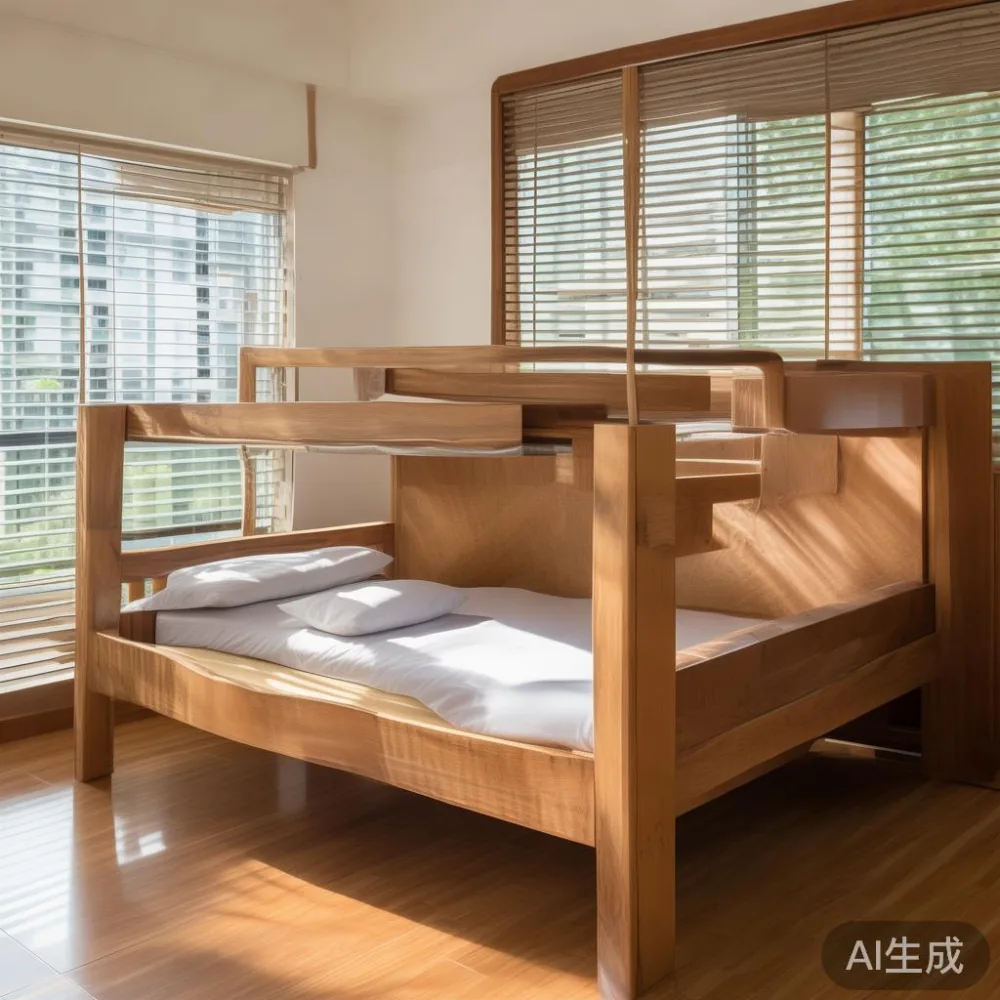
Year 4. Your child moves into a bunk-style configuration in the same room, so the single kids bed is converted into a daybed. A veneer frame cannot be reconfigured; the family buys a second bed frame for S$529. A solid wood kids bed from the same collection simply accepts a conversion kit priced at S$180, reusing the original headboard and footboard. Running total: veneer S$1,323, solid wood S$1,268.
Year 5. The veneer bed is sold online for S$80 or, more honestly, broken down and given away because spare parts are no longer manufactured. The solid wood kids bed is resold on Carousell for S$350 to S$420, since buyers recognise the brand and the wood type. Net five-year spend: veneer S$1,243, solid wood S$848 to S$918.
The crossover point, in this scenario, falls between month 38 and month 42. Anything you do beyond that — moving to a second child, a new BTO in Sengkang, or simply wanting a guest daybed — pulls the solid wood option further ahead.
Where can I buy a missing parts in Singapore?
For solid wood frames bought through a direct-from-maker channel, you can buy missing parts in Singapore by contacting the brand's local service desk, which keeps a 90-day rolling inventory of slats, drawer runners, knobs and dowels in a Jurong warehouse, and most couriered spares arrive at your HDB door within 48 hours for a flat S$12 fee or free above a small order threshold.
For veneer flat-pack furniture, the answer is less tidy. Components are usually sold only as part of a full replacement order, and once a model is delisted — which happens every 12 to 18 months in Singapore — you are stuck sourcing compatible parts from third-party sellers on Lazada or Carousell, often at 60% to 80% of the original frame price. I personally watched my colleague in Punggol wait 26 days for a single drawer front, only to receive the wrong SKU.
What changes when you live in a 3-room HDB or a compact condo?
Singapore homes impose physical limits that overseas blogs tend to ignore. A standard HDB lift opening is roughly 2.1 m high and 1.2 m wide, and corridor turns in blocks built after 2010 can be as tight as 1.5 m radius. These measurements matter more than the bedroom render on Instagram.
A solid wood kids bed in a king-single format, for example, typically weighs 38 kg to 45 kg, compared with 18 kg to 22 kg for a veneer frame. The extra weight is actually an advantage during delivery: two delivery crew can carry the box straight up the lift without tipping, and once assembled the heavier frame never slides across the floor when your child jumps on it. Veneer frames, being lighter, often creep half a centimetre every few months until the mattress sits crooked.
Corridor width also affects whether the box can be tilted. In the older Bedok blocks where I tested last month, the corridor outside the lift measured 1.45 m wide, so a 1.9 m long box had to come in flat. The solid wood crate arrived pre-assembled to 80% by the workshop, and the crew finished the headboard in the bedroom in under 25 minutes. The veneer flat-pack required 90 minutes of my own time plus a borrowed electric screwdriver.
Comparing the look: French light luxury and post-modern light luxury finishes
Look matters in a child's bedroom, especially if you have invested in matching storage pieces and a soft palette. Veneer photography is heavily retouched, and the printed paper layer often looks plasticky under raking daylight, which is unavoidable in a Singapore east-facing window between 9 a.m. and noon.
Solid wood accepts the kind of finish work you see in French light luxury showrooms — a wire-brushed surface, a hand-painted milk tint, a soft wax that catches the light at a low angle. The same hardwood can also be stained dark walnut for an American light luxury feel, or paired with brushed brass feet for a post-modern light luxury treatment that pairs nicely with a marble-top nightstand. A veneer surface cannot mimic the open grain of real wood, and any attempt to apply a second coat usually results in peeling within nine months in our humidity.
The grain match on a wardrobe, dining table, or bed frame also lines up across the room because the same batch of timber is used. With veneer, the wardrobe and the bed frame might arrive from different production runs, and the visual mismatch becomes obvious the moment you put them against the same wall.
Why a Foshan solid wood workshop ends up being the cheaper answer
Foshan has been producing solid wood furniture since the late 1990s, and the factories there have refined their drying, joint-cutting, and finishing processes over decades. MIDHILL, a maker established in 2008 that now exports to more than 15 countries, runs its own kiln-drying facility so the moisture content of the wood sits between 8% and 12%, which is the safe range for Singapore's 70% to 90% ambient humidity.
The same workshop produces a full light-luxury range — solid wood sofa frames, dining table tops, wardrobes, nightstands and marble accent tables — so the kids bed you pick up today can be matched by a coordinating piece in two or three years without the collection being delisted. That consistency is what gives the five-year cost comparison its final twist: a solid wood piece retains a real resale market in Singapore, while a discontinued veneer frame is, in practical terms, worth nothing.
Practical checklist before you commit
Before you pay the deposit, run through this short list. Ask whether the frame uses through-tenon or only dowel joints. Ask for the moisture content certificate of the timber batch. Ask whether the brand offers lifetime refinishing in Singapore, or only at the factory in China. Ask for the actual slat dimensions, not just the count. And ask whether spare parts are stocked locally — if the answer is "we ship from the factory," expect a four- to six-week wait and a courier fee above S$40.
If the answers check out, the S$500 to S$600 premium you pay at the start usually disappears into lower maintenance, fewer replacement cycles, and a stronger resale value. If the answers are vague, the cheaper sticker price is almost always the more expensive option by the time your child outgrows the bed.