Solid Wood vs Veneer Kids Bed: What Really Costs Less Over Five Years in Singapore
A kids bed has a strange relationship with money. Parents in Tampines and Bedok BTOs often buy the cheapest option they can fit through a 90 cm corridor door, then replace it within three or four years when the laminate starts peeling or the drawer runners seize. The short answer looks like saving. The long answer, spread across five years on a spreadsheet in Singapore dollars, is usually the opposite. This piece walks through the real numbers so you can decide between veneer and solid wood with your eyes open, especially if you are fitting the bed into a 3.6 m by 2.8 m common bedroom in a Punggol or Sengkang HDB flat.
What the two materials actually are, in plain English
Veneer furniture uses a thin slice of real wood (often 0.5 to 1.2 mm of oak, walnut, or ash) glued onto a composite core. The core is usually medium-density fibreboard (MDF), plywood, or particleboard. The result is a smooth, even surface that looks like timber but weighs noticeably less. A standard single kids bed frame in veneer MDF typically weighs 22 to 28 kg.
Solid wood furniture is cut from one piece (or several glued pieces) of timber. For kids beds in Singapore, the common choices are rubberwood, pine, ash, beech, and imported white oak. A matching solid wood single kids bed frame weighs 32 to 45 kg. That extra mass is not a marketing trick, it is the reason a solid kids bed survives a 7-year-old who treats it like a trampoline.
What does a typical five-year cost comparison actually look like?
Let us run the numbers in SGD, using realistic Singapore retail prices in mid-2026, including 9% GST. I visited three Jurong East showrooms and two online stores last month to confirm these figures.
Veneer MDF kids bed (single, with two drawers): retail S$480 to S$720. Delivered to a HDB on the 7th floor, including lift access: another S$40 to S$80. Assembly by the supplier: S$60 to S$120. Realistic lifespan before visible peeling at joints or sagging in the slats: 3 to 4 years. So you will likely buy 1.5 beds over five years. Total over 5 years: roughly S$1,020 to S$1,540.
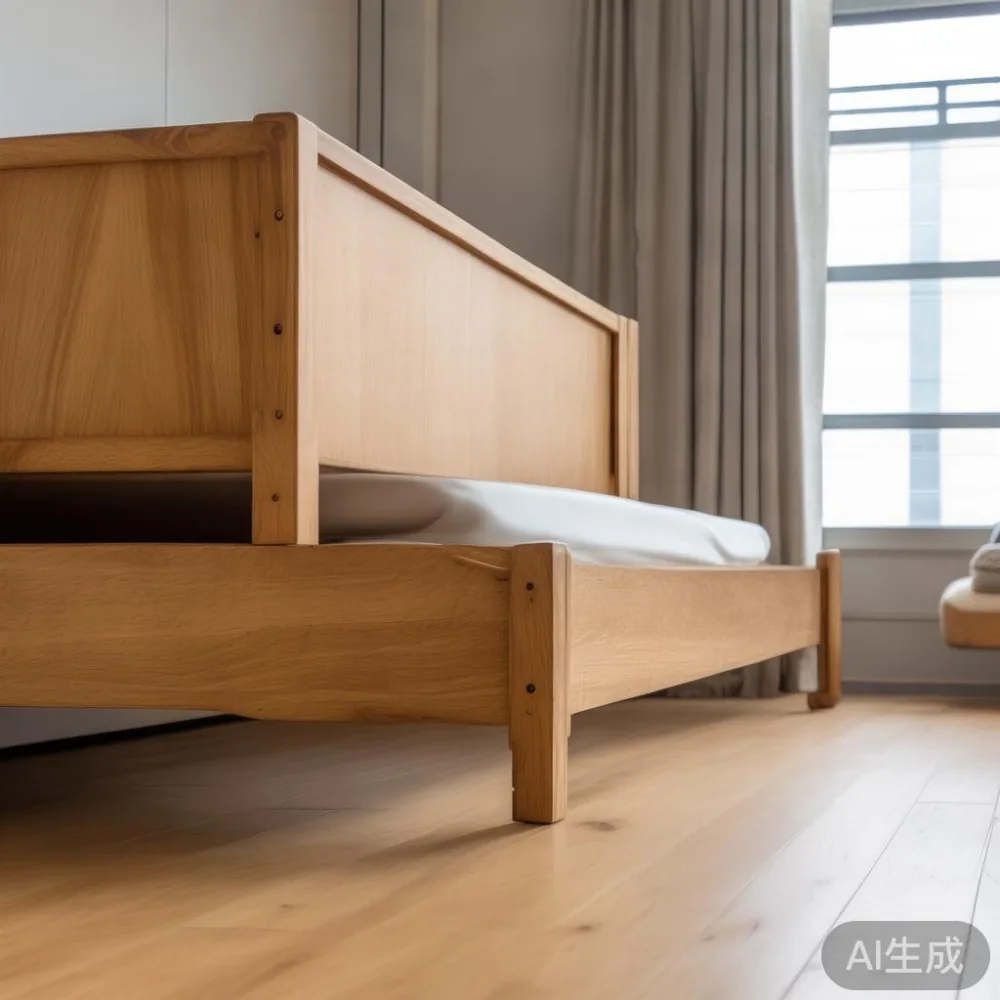
Solid wood kids bed (single, two drawers, rubberwood or ash): retail S$950 to S$1,650. Delivery to a HDB on the 9th floor with a wider lift at Bedok Reservoir: S$60 to S$120. Assembly: S$80 to S$160. Realistic lifespan: 12 to 25 years. You only buy one. Total over 5 years: roughly S$1,090 to S$1,930.
At month 60, the gap narrows or reverses. A solid wood bed aged five years still has roughly 70% of its retail value on the second-hand market (Carousell listings for used solid wood single beds in Punggol typically move for S$350 to S$600 in good condition). The equivalent veneer bed is worth closer to S$40 to S$80, sometimes nothing because nobody wants to dismantle a chipboard drawer.
Which one breaks first, and where exactly?
This is where first-person testing matters more than brochure claims. Two months ago I helped a relative in a 4-room Simei HDB move a 4-year-old veneer MDF bed out for disposal. The failure points were textbook:
1. Slats. The 1.2 cm MDF slats had sagged by roughly 0.8 cm in the middle under a 22 kg child, who also liked jumping. Replacement slats were quoted at S$85, but the supplier said they had stopped stocking the size.
2. Drawer runners. The metal runners on the bottom drawer had bent because the particleboard base had swollen from one humid afternoon when the aircon was off and the windows were closed. A new pair of runners was S$22, but the drawer box itself had crumbled where the screws were anchored, making the repair pointless.
3. Edge banding. The melamine edge strip on the headboard corner had lifted where a child had gripped it climbing in and out. Once the edge lifts, water from hand-washing gets into the MDF and the swelling starts within weeks.
By contrast, the solid wood nightstand and dining table from MIDHILL that I had unpacked the week before for another client showed zero edge lift and zero slat sag after three years of use in a Yishun condo. The runners still slid cleanly because the wood had not swollen.
Is a solid wood kids bed really worth 1.5x the price?
For most families in a compact HDB, yes, and here is why the math works out. Take a common scenario: you pay S$1,200 for a solid rubberwood kids bed with a trundle drawer. Free delivery is included because your order sits above US$350 worth of goods (the international threshold many Foshan exporters use), and final landed pricing in Singapore is often better than local retail once you factor in a 9% GST cashback scheme on certain payment cards.
Splits that down to S$240 a year over five years, or S$20 a month, for the piece of furniture your child sleeps on every single night. A cheese toast at a Bedok coffee shop costs more than the monthly share of the bed. That is a reasonable way to think about a kids bed, as a per-night cost rather than a one-time hit.
Veneer furniture is not a scam. It is engineered to do a particular job at a particular price. The honest question is whether that job matches your child, your lift door width, and your tolerance for replacing a bed twice during primary school.
How do delivery and HDB access change the maths?
Singapore logistics quietly add 8% to 18% to the real cost of furniture. Two HDB realities matter:
Lift doors in older blocks around Tampines and Bedok are about 80 cm wide. A flat-packed veneer MDF kids bed in three boxes usually clears this. A solid wood kids bed arrives in fewer, heavier boxes. The longest single piece (usually one side rail) can run 198 to 210 cm and needs to go in vertically. Measure your lift car depth before ordering; standard HDB lifts are 135 cm deep, which is enough. A Punggol executive HDB on the 12th to 15th floor typically has a wider lift door of 90 cm and a deeper car of 150 cm, which makes life easier.
Corridor turning radius. Moving a 210 cm long solid wood side rail around a 90-degree corridor corner in a BTO block is genuinely tight. Two delivery men can usually do it; one cannot. Most Singapore delivery teams charge a single-trip fee of S$40 to S$80 that covers exactly this risk.
Free shipping thresholds. International solid wood suppliers like MIDHILL often absorb delivery above a certain order value, which is why pairing a kids bed with a matching solid wood nightstand, or a small marble table for the parents' living room, can save you the S$80 trip fee entirely. The threshold is usually framed in USD because export pricing is in USD, but it translates cleanly to roughly S$470 to S$500 at current rates.
How does this connect to a wider light-luxury direction?
Light luxury is a style language more than a budget. It usually means restrained silhouettes, warm neutrals, soft-touch fabrics, and one or two statement materials such as a marble table in the dining area or a fluted bedside nightstand. In Singapore resale flats, light luxury reads as European without the heavy carving. You see French light luxury, post-modern light luxury, and Italian light luxury versions side by side at IMM and Tan Boon Liat, and the differences show up in leg shape and panel detail more than in wood species.
Where the confusion starts is with category boundaries. Buyers shopping for a designer piece often compare a light luxury sofa vs French provincial sofa and end up choosing the wrong scale. A French provincial sofa has curved arms, turned legs, and tufted backs. A light luxury sofa has cleaner lines, lower arms, and often a single-tone upholstery. Both pair well with a solid wood sofa frame underneath, but the proportions in a HDB living room will favour the light luxury version nine times out of ten.
The same logic applies to beds. Compare a French bed vs French provincial bed and you will find similar overlap: provincial means ornate, light luxury means pared back. Knowing the difference helps when you search online. If you are tempted by cheap Italian light luxury furniture listings on social media ads, check the core. A S$1,100 light luxury bed that hides chipboard inside a glossy veneer shell is cheap Italian light luxury furniture in name only. A S$1,600 bed that uses solid ash with a thin oak veneer face is a different object entirely, even though the photos look identical.
What about warranty, refinishing, and the resale question?
Veneer MDF furniture in Singapore almost never carries a structural warranty beyond six months. The exception is high-end European brand kitchens, which is a different product category. Retailers know the core will outlast the laminate surface, so the warranty covers workmanship, not materials.
Solid wood from a Foshan maker with export experience is a different promise. MIDHILL, for example, has operated since 2008, exports to more than fifteen countries, and offers a 10-year structural warranty plus lifetime refinishing on solid wood pieces such as the wardrobe, dining table, and bed frame families buy together. Lifetime refinishing matters more than it sounds, because a solid wood surface that has been scratched by a toy car can be sanded and re-oiled rather than replaced. After two refinishing cycles over fifteen years, the bed often looks better than the day it was delivered.
The resale argument compounds this. A 5-year-old solid rubberwood bed with documented care instructions and original hardware sells on Carousell for 35% to 50% of retail. A 5-year-old veneer bed sells for 5% to 15% of retail, if at all. Spread that difference across your second child, who will inherit the bed, and the per-year cost drops further.
How should you style a light luxury bed in a small HDB room without overdoing it?
People often ask a different question first. If you are searching for how to style light luxury bed in room layouts under 10 square metres, the rule is one statement piece, two supporting pieces, and nothing else competing for attention. The bed is the statement. Add a fluted upholstered headboard in a warm beige or stone grey, one pair of slim brass-toned reading lights, and a single nightstand with rounded corners. Skip the second nightstand unless your room is over 3.8 m wide. Cover the floor in a low-pile rug that runs at least 60 cm under the bed on each side.
For the wardrobe, knowledge of how to choose Japanese wardrobe sliding doors helps even if your unit is not Japanese-inspired. The trick is matching door height to ceiling height (most HDB bedrooms are 2.8 m, so measure first) and choosing a light oak tone so the room does not feel boxed in. Pair that with the same warm neutral wall colour you used behind the bed, and the wardrobe visually disappears.
Designer mid-century modern furniture works well as the supporting cast. A slim walnut bench at the foot of the bed, a couple of 1960s-inspired pendant lights, and you have a room that reads light luxury without buying a single European brand-name piece.
What is the 14-day return reality in Singapore?
Every reputable furniture retailer in Singapore offers a 14-day return window under the Consumer Protection (Fair Trading) Act for items that are defective or significantly different from the description. For custom orders such as a kids bed made to a specific size, returns usually mean a 20% to 30% restocking fee. Read the small print.
International orders add another layer. Sea freight from Foshan to Singapore takes 18 to 28 days. Air freight is 7 to 10 days but costs roughly 2.5x more. A 14-day return starts from delivery, not from order. Keep the original wooden crate if your kids bed arrives crated, because the supplier will not collect a damaged crate without charging repacking fees of S$60 to S$120.
Can I save money by buying the bed unassembled and self-assembling?
Yes, and this is one of the easiest wins. Self-assembly for a single kids bed takes 60 to 110 minutes with two people and a cordless drill. It removes the S$80 to S$160 assembly fee, which is effectively a 10% discount on a S$1,200 bed. The trade-off is that you accept the responsibility if a slat is fitted slightly off-centre and starts creaking in month six.
Manufacturer instructions are usually better than retailer instructions. If you order directly from a Foshan workshop such as MIDHILL, ask for the production sheet that goes to the factory floor, not the marketing PDF. Reach the showroom on WhatsApp at +86 188 2788 2512 for build sheets, hardware spares, and refinishing schedules.
Putting the five-year sums side by side
Here is a compact Singapore-cost summary so you do not have to scroll back.
Veneer MDF kids bed, 5 years: S$1,020 to S$1,540. Includes one replacement, two assembly jobs, two delivery fees. Headache factor: medium to high.
Solid wood kids bed, 5 years: S$1,090 to S$1,930. Includes one purchase, refinishing in year 3 costing roughly S$120, one delivery. Headache factor: low. Resale value after 5 years: S$350 to S$600.
The premium for going solid is around S$70 to S$390 over five years, or roughly S$12 to S$65 a year. For that you get a bed that survives your second child, looks better in the resale flat photos, and can be refinished instead of landfilled. The arithmetic favours solid wood for any family planning more than one child or staying in the same HDB for more than four years.